The prospect you chased for six weeks finally replies:
“Send me your rates.”
What happens next, in most agencies: the reply sits in your inbox. The contact lives in Apollo. The deal lives in Salesforce. The meeting link lives in Calendly. And when the deal finally closes, someone re-types the whole job order into the ATS, client, contact, bill rate, terms, before Delivery can lift a finger.
Sales and BD is the client half of your front office. They prospect hiring managers, win job orders, negotiate bill rates and markups, and hand clean orders to Delivery. The job is simple to state and relentless to do: keep the order book full. The tools were supposed to help. Mostly, they bill.
Six frictions every BD desk knows by heart.
The four-tab prospect
The contact is in Apollo, the deal is in Salesforce, the meeting is in Calendly, the notes are in a doc. Four tools, four versions of the truth, zero shared history when the client calls back in eight months.
The re-keyed job order
The deal closes and the celebration lasts until someone has to re-type client, contact, bill rate and terms into the ATS. Every re-key is a delay, a typo risk, and an hour Delivery spends waiting instead of sourcing.
The follow-up that slipped
Your sequences run in one tool and your pipeline lives in another, so a warm reply updates nothing. The six-week prospect goes cold in the gap between two subscriptions that were both supposed to prevent exactly that.
Rate cards from memory
Bill rates and markups get negotiated deal by deal and stored nowhere queryable. When the client asks for their old rate, or a new AM inherits the account, the answer lives in someone’s sent folder.
“Any word on my candidate?”
The AM who won the order has no window into submittal status, so the update is a walk across the office. Or worse, the client hears silence while the answer sits in a system the AM cannot see.
The pipeline-report hour
Pipeline reviews get assembled by hand: export from the CRM, paste into a sheet, fix the columns, screenshot for the huddle. An hour of every week spent describing the pipeline instead of selling into it.
Five subscriptions. One desk.
A serious BD desk ends up carrying a CRM, a data tool, a sequencer, a LinkedIn seat and a scheduler, per rep, per month. All prices est., current list.
A BD seat today
Before a ZoomInfo contract, typically $15K to $25K a year (est.).
The same jobs, on Zoho
Plus the data tool you choose to keep (~$50 to $100). Even then, roughly 75 to 80% lower per seat. Annual pricing, USD list.
One pipeline. Every conversation attached.
Not a diagram. The actual product. Zoho CRM runs your job-order pipeline with accounts, contacts, deals, emails and meetings on one record, Blueprint enforcing your stages, and Zia scoring every deal.

Won in CRM. Sourcing within the hour.
That’s Zoho Flow doing the handoff, the flagship automation on this desk. The account manager never re-types an order. Delivery starts sourcing the same hour the deal closes.
Web visitor → routed lead
SalesIQ spots a target account browsing your site → the lead is auto-created, Zia enriches it, round-robin assigns it → the rep gets a Cliq alert while the visitor is still on the page.
MSAs drafted for approval
Deal fields merge into a Zoho Writer template → the MSA or fee agreement is ready for your review, then out for e-signature via Zoho Sign → the signed copy is filed against the account. No blank-page drafting, no chasing, no lost PDFs.
The submittal feedback loop
When Delivery’s submittal status changes in Recruit, the account manager gets a Cliq ping in real time. The client hears news from you, not the other way around. The walk-over is retired.

The handoff to Delivery is no longer a meeting.
It’s a timestamp.
The week, when the pipeline carries the admin.


The huddle runs on a live screen
No exports, no paste-into-a-sheet hour. The funnel dashboard, leads to meetings to orders to filled, is already current in Zoho Analytics, and the calls-and-meetings leaderboard settles the “who is actually prospecting” debate before coffee is finished.
A target account is reading your rates page
SalesIQ flags it, the lead is created and enriched, and the owning rep gets the Cliq alert with the pages the visitor viewed. The follow-up email goes out while the interest is minutes old, with a Bookings link that fills a slot the same afternoon.
Won, then sourcing, inside one hour
The deal hits Won, Flow builds the job opening in Recruit with client, contact, bill rate and terms carried over, the fee agreement leaves via Sign, and Delivery is pinged in Cliq. The AM’s only remaining job is the thank-you call.
Status before the client asks
Submittal pings have landed in Cliq all week, so the client call opens with “here is exactly where your three roles stand,” from the same record the recruiter is working. The week closes with the order book, bill rates and markups all in one queryable place.
The apps this team lives in, and what each one does here.
The workflow comes first. These are the apps we wire around it. Not a feature list: the jobs each app does on a staffing BD desk, specifically.
Zoho CRM
- Job order pipeline with bill rate and markup captured on the deal itself
- Account plans and stakeholder maps for MSP and VMS programs
- Credit-hold flags from Finance visible before the next order is taken
- QBR prep views per client: orders, fills, rates, open submittals
Zoho SalesIQ
- Target-account alerts when a prospect reads your rates or services pages
- Zobot qualifies after-hours hiring managers and captures the lead
- Chat transcripts filed to the lead record, not a separate inbox
- Visitor scoring that tells reps who to call first
Zoho Bookings
- Self-serve intake-call links in every outbound email
- Round-robin routing across account managers by territory or vertical
- Automatic reminders that cut client no-shows
- Every meeting written straight to the CRM record it belongs to
Zoho Campaigns
- Dormant-account reactivation nurture pulled live from CRM, no CSVs
- Client newsletter with hiring-market notes and placement proof
- Opens and clicks write back to the account, so reps call warm
- Webinar and event invites segmented by industry and role
Zoho Sign
- MSAs and fee agreements merged from deal fields via Writer templates
- Signature status tracked per signer, chased automatically
- Signed copies filed against the account, findable at renewal
- Rate-card amendments signed without a fresh paperwork cycle
Zoho Flow
- Won deal becomes a Recruit job opening, nothing re-typed
- Submittal status changes ping the owning AM in Cliq
- Apollo and ZoomInfo leads sync into CRM automatically
- Stalled-deal nudges when a stage sits too long
Zoho Cliq
- Deal-won alerts to the whole desk the moment they happen
- Submittal and interview pings so AMs never chase Delivery
- A channel per major account for the team that serves it
- Huddle channel fed by the live leaderboard
Zoho Analytics
- Funnel dashboard: leads to meetings to orders to filled
- Client concentration gauge, watched weekly
- Average bill rate and markup across open orders
- Calls-and-meetings leaderboard the huddle runs on
One glance, every Monday morning.
Zoho Analytics joins CRM, Recruit and Books natively, and presents this desk as a funnel dashboard, an account-revenue cohort chart, a client-concentration gauge and the leaderboard your huddle runs on. Live, no exports.
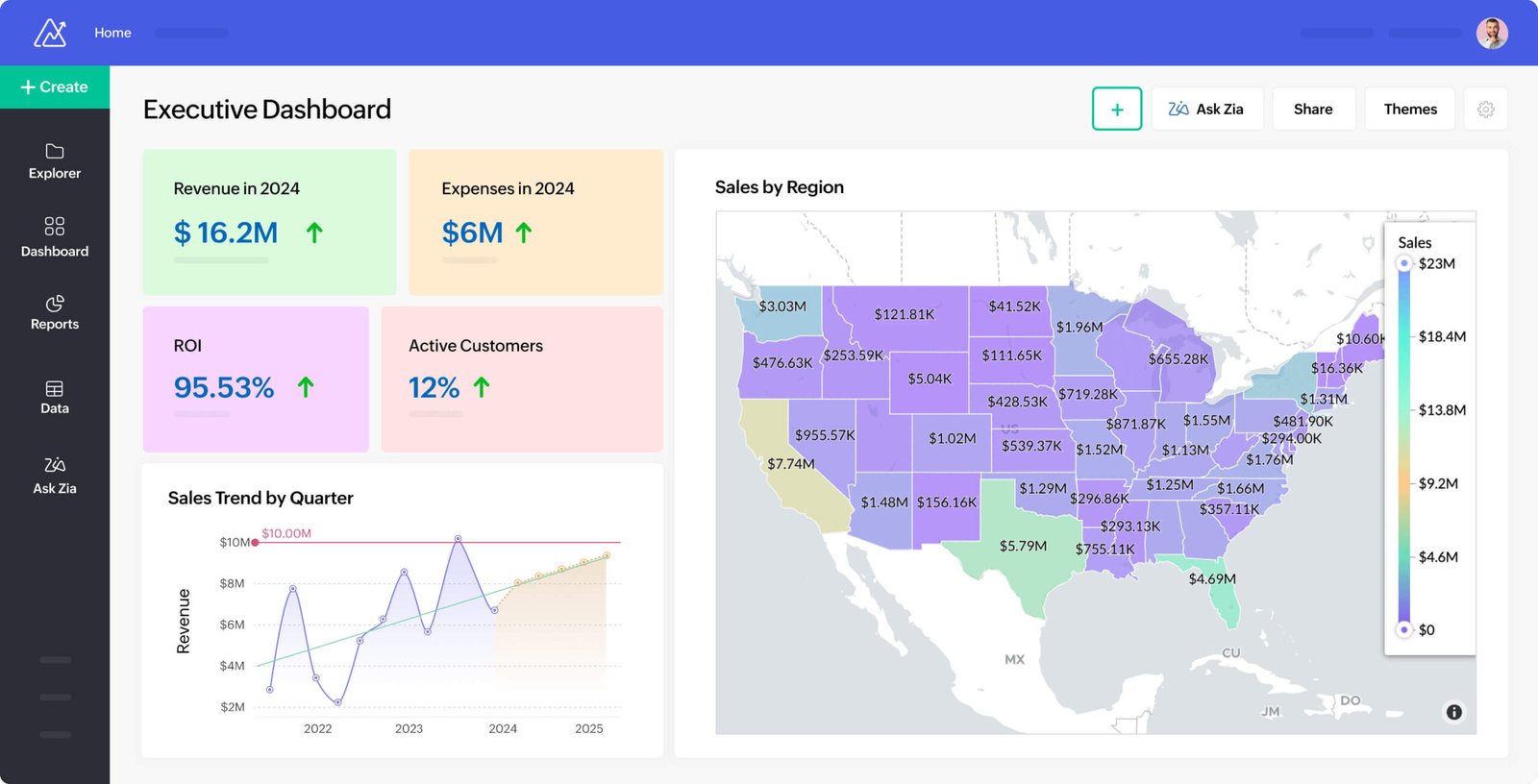
Illustrative view of the numbers on it:
new job orders this week, tracked per account manager
connect-to-meeting rate across the team
fill rate on this desk’s orders. Sales owns order quality too
average bill rate across open orders, with markup beside it
revenue from top-5 accounts. Concentration, watched weekly
revenue per account, cohort by cohort, year over year
Every subscription, mapped honestly.
The short version, including the two tools worth keeping.
| You’re paying for | Zoho One does it with |
|---|---|
| Salesforce / HubSpot CRM | Zoho CRM, with Blueprint process enforcement and Zia scoring included. ✓ |
| Apollo / ZoomInfo | Keep it. Zoho has no B2B contact database, and Apollo plugs straight into Zoho CRM. |
| Outreach / SalesLoft | CRM cadences + SalesInbox + Campaigns. Right-sized for SMB outbound volume. |
| LinkedIn Sales Navigator | Keep it if it earns its keep. No equivalent exists. It runs happily alongside. |
| Calendly | Zoho Bookings. ✓ |
| Website visitor intel | Zoho SalesIQ. ✓ |
| Slack | Zoho Cliq. ✓ |
| Spreadsheet pipeline reports | Zoho Analytics, joined natively to Recruit and Books. ✓ |
The first 30 days on this desk.
Week 1: the pipeline, rebuilt to your stages
We audit the current stack, configure Zoho CRM around your actual sales process, lead sources, deal stages and rate-card fields, and migrate accounts, contacts, deals and notes from Salesforce, HubSpot or spreadsheets.
Weeks 2 and 3: the automations go live
Blueprint enforces the process, Bookings links replace Calendly, SalesIQ goes on the site, cadences replace the sequencer, and the flagship Won-deal-to-Recruit handoff is wired and tested with a real order.
Week 4: the huddle runs on the dashboard
The funnel dashboard, concentration gauge and leaderboard go live in Analytics, and we train the team inside their own huddle, on their own pipeline, not demo data.
Sales isn’t your department. It’s one of your hats.
In a small shop, BD is what the owner does between screening calls, which makes a $460-per-seat stack absurd. Zoho One prices by employee, not by function: the $37 login that runs your sales hat also runs your recruiting hat, your marketing hat, your compliance hat and your books. One database under all of them.
What sales leaders ask us.
Do we have to give up Apollo or Sales Navigator?
No. Zoho has no native B2B contact database and no Sales Navigator equivalent. We say so on this page and in every quote. Both plug into Zoho CRM, and even keeping them most desks land roughly 75 to 80% lower per seat.
Is Zoho CRM actually enterprise-grade, or the budget option?
Blueprint process enforcement, Zia deal scoring and forecasting, territories, cadences and workflow automation are all included in Zoho One. Salesforce sells those features in higher tiers. The budget part is the price, not the toolset.
What happens to our Salesforce data?
It moves. Accounts, contacts, deals, notes and attachments migrate as part of the implementation, mapped to your new pipeline and deduped on the way in. You keep your history and your renewal dates.
Is Zoho Recruit included in Zoho One?
The Staffing Agency edition is a separate purchase ($25 to $75/recruiter/mo). It matters for Delivery, not for this desk. BD seats only need Zoho One. We show every line item separately in every quote.
What decides $37 vs $45 per employee?
Zoho One’s $37 all-employee price applies when every employee gets a licence. The $45 flexible-user price applies when only some do. For a small agency the all-employee plan is almost always the right call, since every hat needs the login anyway.
How fast does the Won-deal handoff pay off?
Immediately. It is usually the first automation we switch on. Every won deal after go-live becomes a sourced-same-hour job order, and the re-keying delay between Sales and Delivery drops to a timestamp.
Selling looks different by industry.
See your sales stack,
line by line.
A Staffing Systems Review is a business conversation with people who have run recruiting businesses, 30+ years in recruitment and 14+ recruiting firms behind them. We map what moves into Zoho One and what’s worth keeping, no slideware, and you leave with a gap map of your systems either way.
Book a Staffing Systems Review